Split-level deck ideas usually sound exciting at the start of a project. Homeowners picture a more dynamic outdoor space, better flow from the house to the yard, easier access to the side yard, and a smarter way to break up a sloped backyard. The appeal is real. A multi-level deck can absolutely add dimension, improve daily use, and make the whole property feel more intentional. But this is where a lot of people get ahead of themselves. They fall for the extra levels, then wait too long to ask whether the design will still feel practical once rain, furniture, muddy shoes, and real life move in.
That question matters in Seattle. A multi-level layout can elevate a property in all the right ways, but it can also create more transitions, more drainage concerns, and more places where a beautiful idea becomes a maintenance problem. In our work at Olympic Decks, the split-level projects that hold up best are the ones where the deck design is doing real work. The levels are not there just for style. They are there to create better circulation, better use of space, and a more comfortable kind of outdoor living.
Multi-level deck ideas work best when each level has a purpose
The strongest deck ideas usually start with a simple question. What is each part of the deck supposed to do, and what would be the ideal use for each level?
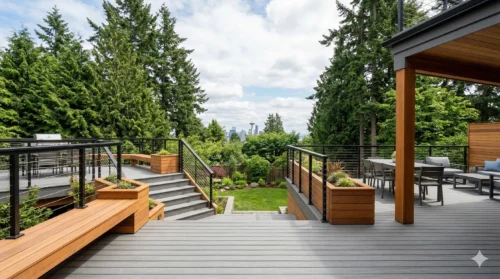
A good multi-level deck does not just stack one platform above another or replace a clear plan with extra height. It creates defined zones that feel natural in daily use, which can also improve safety and accessibility. The upper deck near the back door often makes sense for dining, grilling, or morning coffee. A lower-level deck can be better for relaxing, reading, or quieter evenings away from the traffic closest to the house. Once the levels have distinct roles, the whole layout starts to feel clearer.
That is also what keeps the design from becoming high maintenance. When the space is organized around real use, the furniture has somewhere logical to sit, circulation stays open, and one section is not forced to do everything. The deck feels calmer. The upkeep usually gets easier, too.
Let the site shape the deck design instead of forcing one flat platform
One of the best design ideas for a Seattle yard is also one of the most practical. Work with the grade.
For uneven yards, a multi-level deck is often more practical than one oversized platform. It can break the structure into sections that follow the grade, rather than creating one large mass above the yard or forcing a stairway where the slope already leads naturally toward the lawn. That usually makes access smoother and helps the deck transition more naturally to the patio, lawn, or walkway. It is a stronger choice when the slope is uneven across the property or when a straight stair run would feel cramped.
This is where thoughtful deck building stands apart from trend chasing. Good designers understand that extra levels should solve a site problem, not create one. A modern deck tends to look better when it respects the lot instead of pretending the lot is flat, especially when brick paths, planting beds, or existing landscaping already shape how people move through the yard.
A modern upper deck should not feel disconnected from the yard
An upper deck can be one of the most useful parts of a multi-level deck, but only if it still feels connected to the rest of the property. This is the point where layout and deck staircase planning in Seattle become more important than they may seem at first.
When an upper deck level sits too far above the yard with no comfortable transition, the structure can feel separated from the rest of the outdoor living area. The right stair placement helps solve that.1 So do strong railing lines and clear views into the backyard, which make the upper level feel like part of the whole design rather than a raised island.
There is also a practical maintenance angle. If the traffic flow makes sense, people stop fighting the layout. They move furniture less awkwardly, use more of the deck, and avoid turning one corner or one level into a neglected zone.
Pool deck and hot tub zones should feel deliberate, not squeezed in
A pool deck or hot tub area can fit beautifully into a multi-level deck, but this is where many nice-looking concepts start getting risky. Water changes everything. It affects traction, drainage, cleaning, and how materials age over time.
If a pool or hot tub zone is part of the dream, it should be given its own level or its own clearly separated part of the layout. That creates better safety, helps manage splash patterns, and protects the areas meant for dining or entertaining from becoming permanently damp. It also keeps the design from feeling crowded. A pool deck should not read as an afterthought jammed onto one side of the structure.
This is one of those cases where extra levels can genuinely improve function. The right split lets wet and dry uses coexist without competing for the same outdoor space.
Natural wood can still look modern if the lines are disciplined
A lot of homeowners assume modern automatically means gray composite and sharp black metal. That route can work, but natural wood should not be ruled out. It can still feel modern when the design is simple enough to let the material look intentional.
The real difference comes down to design control. Clean proportions, a well-matched railing, smooth transitions between levels, and a layout that does not pile on too many ideas can give a wood deck a very current look. The material does not have to be the problem.
Maintenance is where homeowners need to be clear-eyed. A rich wood finish will not hold itself forever. Regular staining or a fresh stain when needed may be required to keep the deck looking the way it was intended to look. In Seattle, moisture management, mildew resistance, and timing matter because a long-lasting deck finish needs dry conditions before and after application.2 New wood also needs time to season before staining, with moisture content at 15% or less. Modern style should not come from pretending maintenance does not exist. It should come from choosing a finish and material approach that still feels good once the deck has actually lived through a few wet seasons.
For Seattle decks, maintenance planning often comes down to a few practical numbers:
| Detail | Practical range / number |
| New wood seasoning before stain | 4–12 months |
| Wood moisture before staining | 15% or less |
| Dry weather window before/after staining | 24–48 hours minimum |
| Best staining temperature range | 50°F–90°F |
| Stair handrail height | 34–38 inches |
Covered levels work best when they protect the part of the deck people use most
Not every split-level deck needs a full roof. In many cases, the smarter move is to cover only the section that benefits most from weather protection.
Usually, that means the upper level closest to the house, where people want dependable shade over lounge seating or a dining table. A covered upper section can create a more useful outdoor living zone while leaving the lower level open to light and air. That balance often feels better than roofing the entire structure and making the backyard feel heavier.
This is where louvered roof systems fit especially well. They give homeowners flexibility without forcing the deck into a closed-in look. They can also help protect cushions, finishes, and lights, which matters when people are trying to create a deck that still feels easy to maintain. The same logic applies to pergolas, which can make multi-level decks more functional without turning the whole structure into a fully covered space.
The space under one level should not become wasted space
One of the most overlooked split-level deck ideas has nothing to do with the top surface. It has to do with what happens below.
If one part of the multi-level deck sits over another usable area, that lower space should be treated as real outdoor living space, not leftover square footage. A dry lower level can become a real extension of the backyard, whether for relaxation, storage, or a more sheltered seating area. A wet one usually turns into the part of the deck nobody wants to use.
That is why keeping the space below dry belongs in the planning stage, not at the very end. Water dripping through an upper level does not just make the lower area less appealing. It can also make the whole design feel unresolved.
The cleanest design ideas usually age better
A lot of modern inspiration online pushes homeowners toward more complexity. More material changes. More decorative patterns. More dramatic shifts between levels. More details that look featured in photos but ask for extra cleaning, extra alignment, or future repair.
The decks that tend to age best are usually more restrained. They use fewer moves, stronger proportions, and clearer zones. They create interest through level changes, circulation, and the relationship to the house, porch, patio, and landscaping, not through constant decoration.
That is where a good builder becomes essential. Homeowners who are still seeking the right team should spend time learning what to look for before hiring a contractor. A strong contractor should be able to explain not just how to build the deck, but why one layout will hold up better than another once weather, use, maintenance, and deck inspections for multilevel decks enter the picture.
The best multi-level deck does more than look beautiful on day one. It should create better outdoor living, maximize the usable space, and make the property feel more connected from the back door to the far end of the yard. It should elevate the experience of being outdoors without quietly making upkeep harder.
That is the real difference between stylish deck ideas and intelligent deck ideas. One gives you a short burst of inspiration. The other gives you a deck that still feels smart when the project is no longer new, the family is actually using it, and the design has to do more than impress guests. It has to work.
FAQ
Are split-level deck ideas harder to maintain than one large deck?
A well-planned multi-level deck can actually make maintenance easier by improving drainage, circulation, and usable zones.3
Does a multi-level deck work better on a sloped backyard?
Often yes. A multi-level layout usually handles a slope more naturally than forcing one oversized flat platform across uneven ground.
Can an upper deck still feel connected to the yard?
Yes. The right stairs, sightlines, and railing layout can keep an upper deck from feeling cut off from the rest of the property.
Is natural wood too high-maintenance for a modern deck?
Not necessarily. Natural wood can look modern when the design is disciplined, but homeowners should expect some upkeep, including occasional deck staining.
Should a pool deck or hot tub be on its own level?
In many cases, yes. Giving a pool deck or hot tub area its own zone usually improves safety, drainage, and overall layout.
Is it worth covering only one section of a split-level deck?
Usually yes. Covering the most-used level can improve comfort and help protect finishes without making the whole deck feel heavy.
What should I ask before hiring a contractor for a multi-level deck project?
Ask how they approach layout, drainage, privacy, traffic flow, deck stairs repair signs, and long-term maintenance, not just appearance.
Why does the lower space under a deck matter so much?
Because if it stays wet and unusable, it reduces the value of the whole design. If it stays dry, it can become real usable outdoor space.

Olympic Decks is your Seattle area Deck Company, We specialize in all your Decking needs – new deck installation, deck resurfacing, louvered roof and cedar wood fence installation.