Deck staircase planning, Seattle homeowners often treat as a secondary detail, can become one of the most important decisions in the entire build. That usually does not seem obvious at the start. Most people focus first on appearance: the size of the deck, the color of the boards, the railing style, and how everything will look from the house. They rarely stop to think about deck contractors, the location of the stair run, or whether the stair layout will work with the ground, the backyard, and the rest of the outdoor space. Stairs usually come later, as if they simply link the structure to the yard. Still, they do much more than that.
A staircase shapes how the deck feels in real use. It affects movement, entry and exit points, usable space on the platform, and whether the finished project feels easy and natural or slightly awkward. In Seattle, where yards are often sloped, damp, or smaller in practice than they seemed during planning, that matters even more. A stair layout that looked acceptable in theory can take too much space, interrupt the natural path through the yard, or create avoidable drainage and maintenance issues. On some sites, the stairs also compete with a patio, cut too close to the edge of the usable area, or leave only a few inches where the transition should feel open.
That is one of the more obvious lessons from actual work in the field. The experience from Olympic Decks shows that staircase problems rarely begin with the stairs alone. They usually begin when the stairs were never fully integrated into the structural and functional logic of the deck.
The staircase changes how the whole deck frame works
A deck is experienced through movement, and the staircase starts shaping that experience immediately. It influences where people naturally go, how they access the backyard, how easy it is to carry outdoor furniture, and whether the transition from the house to the yard feels smooth or strained. On a good layout, the stairs feel settled. They land where they should, the proportions are comfortable, and the route feels intuitive. On a weak layout, they stay noticeable every time they are used. That becomes even more obvious when the frame is doing one thing on paper, but the actual walking path from the house to the yard asks for something else.
That is not just cosmetic. A staircase that is too steep, too narrow, poorly positioned, or disconnected from the actual use of the yard affects the function of the entire build. A deck can look refined in photographs and still feel frustrating in daily life when the stairs are treated as an afterthought instead of one of the main structural choices.
Why Seattle makes staircase planning more demanding
Seattle is not forgiving of outdoor construction. Moisture stays around longer. Shade slows drying. Many properties have grade changes that complicate straightforward layouts. On some sites, deck builders and deck contractors also have to account for rain, soft earth, and uneven fill before they can plan the stair run with confidence. That is part of why floating decks tend to make more sense in areas without deep winter frost, while more traditional deck structures in colder climates usually need to be anchored deeper in the ground to avoid upheaval and require more extensive foundation work. All of that raises the stakes for stair planning.
Stairs often sit lower than the main deck, closer to splashback, soil moisture, and planting areas. They also create more edges and transitions where water can collect or move in ways homeowners do not anticipate. That is one reason managing water around your deck structure is not a side issue. It needs to be considered while the staircase is still being designed, not after materials are installed.
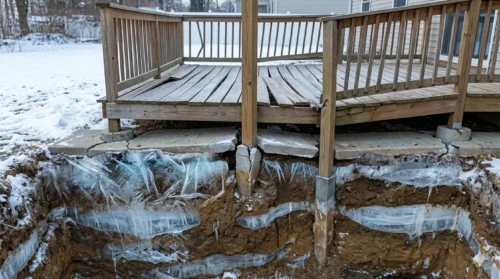
A staircase can make drainage either better or worse depending on how it lands, how it is framed, and how it interacts with the surrounding grade. On a flat lot, mistakes may take longer to show themselves. On a Seattle property with slope, shade, and wet seasons, they surface faster. That is especially true on a floating deck or ground-level deck, where the relationship between the stair landing, the ground, and the drainage path needs more attention from the start. In Seattle’s damp climate, floating decks are more vulnerable to moisture-related rot, and winter soil movement can force periodic re-leveling if the base and drainage strategy were not handled properly. Proper drainage matters here because water collecting under the structure can shorten its life.
The cost question usually shows up later than it should
Homeowners often assume the stairs are a relatively fixed piece of the budget, but that assumption rarely holds once design choices become more specific. A staircase is rarely as simple as it first looks. The direction of the run, the number of steps, the amount of railing, the need for landings, and the connection between the stairs and the main structure all affect material needs, labor hours, and framing complexity. Something that looks clean in concept can require much more structural coordination once the build is laid out properly. That can mean extra joists, beams, joist hangers, screws, and more careful support at key load points.1 A wider stair run may improve comfort and flow, but it also adds weight to the labor and material side of the project. A switchback can make sense in a tighter yard, though it solves one problem by adding another.
That is why stair planning should happen early, while the full budget is still being discussed. It is not just a matter of looks. It is one of the reasons the total cost lands where it does. For homeowners trying to understand what deck builders in Seattle typically charge, the staircase is often one of the pieces that quietly shifts the final number more than expected.
Before getting deeper into layout choices, it helps to look at a few hard numbers that explain why deck stair planning in Seattle is more demanding than it first appears. On some projects, those numbers also affect permits, installation, and how a complete stair plan comes together before crews ever install materials on site. That matters even more on lower deck structures, since floating decks in Seattle are often treated differently for permitting when they stay under 30 inches high, and decks less than 18 inches above the ground are often exempt from permit requirements.2
| Planning factor | Figure | Why it matters |
| Maximum stair riser height | 7 3/4 in. | Taller risers can make stairs feel steeper and less comfortable in daily use. |
| Minimum tread depth | 10 in. | Shallow treads reduce footing comfort, especially in wet conditions. |
| Minimum clear stair width | 36 in. | Width affects how usable the stairs feel when people carry furniture, bags, or move in both directions. |
| Handrail height | 34–38 in. | Handrail placement changes how secure the staircase feels in real use. |
| Mean annual precipitation in Seattle | 37.1 in. | Moisture exposure is part of why drainage, drying, and stair detailing matter so much locally.3 |
The biggest planning mistake is separating design from use
A lot of staircase decisions are made visually first. Homeowners imagine how the deck will look from inside, how the railing lines will read, and how the stairs will balance the shape of the structure. They may picture the perimeter, the corners, the line toward the door, or how the deck relates to a nearby patio. That is understandable, but it creates problems when appearance leads, and function follows too late.
A broad, front-facing staircase often seems like the obvious choice because it opens the deck toward the backyard. Sometimes that works well. Sometimes it channels too much traffic into one area, limits furniture layout options, or creates drainage problems at the landing. Moving the stairs to one side may preserve more usable deck surface, but if that route feels out of place or disconnected from how the yard is used, the design begins to push against itself. Stair planning should not be reduced to preference. It has to reflect movement, site conditions, and structural needs. The right staircase is the one that continues to work once the deck becomes part of everyday living.
Composite decking and other materials behave differently once they become stairs
Material choices often feel straightforward when homeowners are looking at samples, but they become more complicated on stairs than on a flat deck surface.
Wood remains appealing for obvious reasons. It feels familiar, works well visually with many homes, and can produce a timeless result when well-detailed. Pressure-treated wood is often part of that conversation, especially when the stair structure sits closer to the ground and deals with repeated moisture. In many floating deck layouts, the deck frame itself is typically built with pressure-treated lumber for durability.4 But in Seattle conditions, wood stairs are also exposed to dirt transfer, slower drying, and more wear from everyday use.
That is another reason staircase thinking belongs inside the earliest phase of planning a new deck project. Once the project is framed around real use and site conditions, the material decision becomes much easier to make intelligently.
Safety is shaped before the build starts on a ground-level deck
Many people think about stair safety in code terms: railing height, tread depth, riser consistency, and inspections. Those things matter, but real-world safety begins earlier, in planning. On a floating or low-built stair system, even small decisions about depth, distance, and support can change how secure each foot placement feels.
A staircase can meet code and still feel wrong to use. It may pass inspection and still create a transition that feels tight, abrupt, or awkward underfoot, which is often how early deck stair repair signs first show up in real use. In most cases, that is not an installation issue. When the route feels forced, the proportions are off, or the connection to the deck and yard is weak, the stairs can feel less stable even if they fully comply on paper.
Homeowners do not use a deck like a display piece. People carry drinks, move chairs, walk outside in damp shoes, bring children or guests through the space, and use stairs in dim light. A staircase has to support all of that naturally. Good planning does not just protect code compliance. It protects comfort and trust in the structure.
Why the smartest staircase often feels the least dramatic on a floating deck foundation
There is a tendency to assume the best design move is the boldest one. In actual deck construction, the best staircase is often the one that feels least forced. It belongs to the deck, respects the yard, and does not overtake the layout or feel hidden. On some low-profile layouts, that may even mean thinking about a floating deck foundation, deck blocks, concrete deck blocks, a compact block layout, and whether a paver base, gravel, or pavers under key points make the landing area more stable over time. A floating deck typically rests on blocks at ground level rather than being anchored deeply into the ground, which is why a stable, compacted gravel base matters so much. Concrete deck blocks can be a cost-effective alternative to more traditional concrete foundations, and those foundation blocks usually need to be set in a grid pattern to support the deck frame evenly. That kind of prep can also involve clearing sod, checking spacing in clean rows, and deciding whether a shovel adjustment now avoids a bigger correction later.
That kind of result usually comes from restraint and clarity, not from trying to make the stairs look impressive at all costs. A well-planned staircase can improve the appearance of a deck, but its deeper value is functional. It lets the outdoor space breathe, preserves usable room where it matters, supports drainage, and fits the structure instead of fighting it. That is often the point where a practical stair layout becomes a great addition instead of just another visual feature attached to the project. In many cases, the best idea is also the least dramatic one, even if it feels a little more restrained than what the homeowner first pictured. The staircase is not a finishing touch. It is one of the decisions that determines whether the finished deck feels intelligent.
Why this matters long after construction ends
A lot of design choices look fine in the first month after a build. Stair planning proves its value later.
It proves itself when the yard is wet, and the route still feels natural, when furniture moves easily between levels, and when drainage issues do not start showing up at the base of the stairs. It also proves itself when the stair landing does not settle into the grass, when the paver base or gravel below stays stable, and when the area still feels easy to maintain through the rest of the year. The real test comes later, not at the finish line. It shows in whether the deck still feels comfortable after years of regular use.
That is why stair planning deserves more attention upfront. The cost of doing it properly is built into the project. The cost of doing it poorly tends to show up over time—through inconvenience, limited usability, maintenance demands, or larger fixes. On some jobs, that means crews have to dig again, re-level the ground, patch a soft hole, or redo part of the landing after the original laying pattern no longer works. In the worst cases, what should have been a small correction turns into tearing out half the landing area just to get the stair transition working properly again. Even after the build is finished, regular cleaning, inspection, and protective sealing can make a real difference in how well a lower deck structure holds up over time.
In Seattle, where decks need to perform beyond ideal weather, a staircase should help the structure feel complete, durable, and easy to use. When it does, it becomes part of a high-quality products conversation, a smarter project outcome, and, in the best cases, a genuinely great project result that improves daily life in the backyard.
FAQ
Why should deck stairs be planned early in a Seattle project?
The stair location affects layout, drainage, framing, and how the deck connects to the yard. It also affects whether the stairs work with an existing deck, an attached structure, or a freestanding layout that needs to be anchored differently.
Do deck stairs change the total cost of a new deck?
Yes. Stair width, direction, railing, landings, and site conditions all affect total cost.
Why are stairs harder to plan on Seattle properties?
Seattle lots often have slope, drainage issues, shade, and tighter outdoor layouts that make stair placement more demanding. On some sites, frost line conditions, drainage paths, and the need for landscape fabric, paver base, or deck blocks under certain support points make the prep work more technical.
Is a straight staircase always the cheapest option?
Not always. It may be simpler structurally, but it can take up more yard space and create layout problems.
Can poor stair planning affect drainage?
Yes. Stairs can redirect water, trap moisture, or complicate runoff if they are not integrated properly into the deck plan.
Should staircase layout be part of deck design from the beginning?
Yes. Waiting until the end usually limits options and can create structural or functional compromises. It is better to think ahead, account for materials, and decide early whether the landing area needs more prep, a cleaner base, or a different relation to the patio and backyard.
Do materials matter more on stairs than on the main deck?
In many cases, yes. Stairs deal with concentrated foot traffic, moisture, and wear in a more demanding way. Board choice, composite option, fastening method, and overall detail level all have more visible consequences on stairs than on flatter parts of the deck.
What makes a deck staircase feel right in daily use?
Comfortable proportions, a natural path to the yard, good drainage, and a layout that fits how the space is actually used. Good lighting, sensible depth, enough inches where people actually step, and a landing that does not feel cramped also matter more than homeowners first account for.

Olympic Decks is your Seattle area Deck Company, We specialize in all your Decking needs – new deck installation, deck resurfacing, louvered roof and cedar wood fence installation.