
Key Takeaways
- In Pacific Northwest conditions with frequent cloud cover and morning moisture, composite decking and modern deck boards stay cooler than most homeowners expect based on national online advice.
- Cloud cover limits sustained UV exposure, morning dew creates evaporative cooling on non-porous composite, and modern color technology reflects more solar energy than boards from 15 years ago.
- Wood can feel slightly cooler only during the 15-20 truly cloudless, low-humidity summer days Seattle sees each year.
- Airflow beneath the deck often matters more than surface material for barefoot comfort, because it directly affects the surface temperature your feet actually feel.
- Regional deck and fence contractors see these results across real-world projects in Washington.
Why “Composite Decks Stay Cooler” Is Not Just a Desert Question
Search for “does composite decking get hot,” and you will find page after page of warnings written for Arizona patios and Texas pool decks. That advice assumes 8 hours of full sun baking a surface at 105°F ambient, the kind of heat absorption you see in hotter climates or on something closer to a salt flat than a Seattle backyard. It does not describe a Seattle July afternoon.
Olympic Decks has spent years building and resurfacing decks across the Northeast, and the question comes up constantly: Will my new composite boards scorch bare feet, or will the right decking choice keep my outdoor space comfortable? The honest answer surprises most homeowners who did their research on national websites.
The “composite gets hotter than wood” claim rests on thermal mass theory. Materials that store more heat energy should feel hotter, right? That logic works perfectly when the sun hammers a surface all day. It falls apart when clouds roll through every few hours, when morning dew sits on the boards until 10 a.m., and when regional humidity changes how surfaces absorb and release energy. In real Pacific Northwest conditions, modern composite matches or beats aging wood on barefoot comfort more often than not.
Composite vs Wood On A Typical Seattle Day
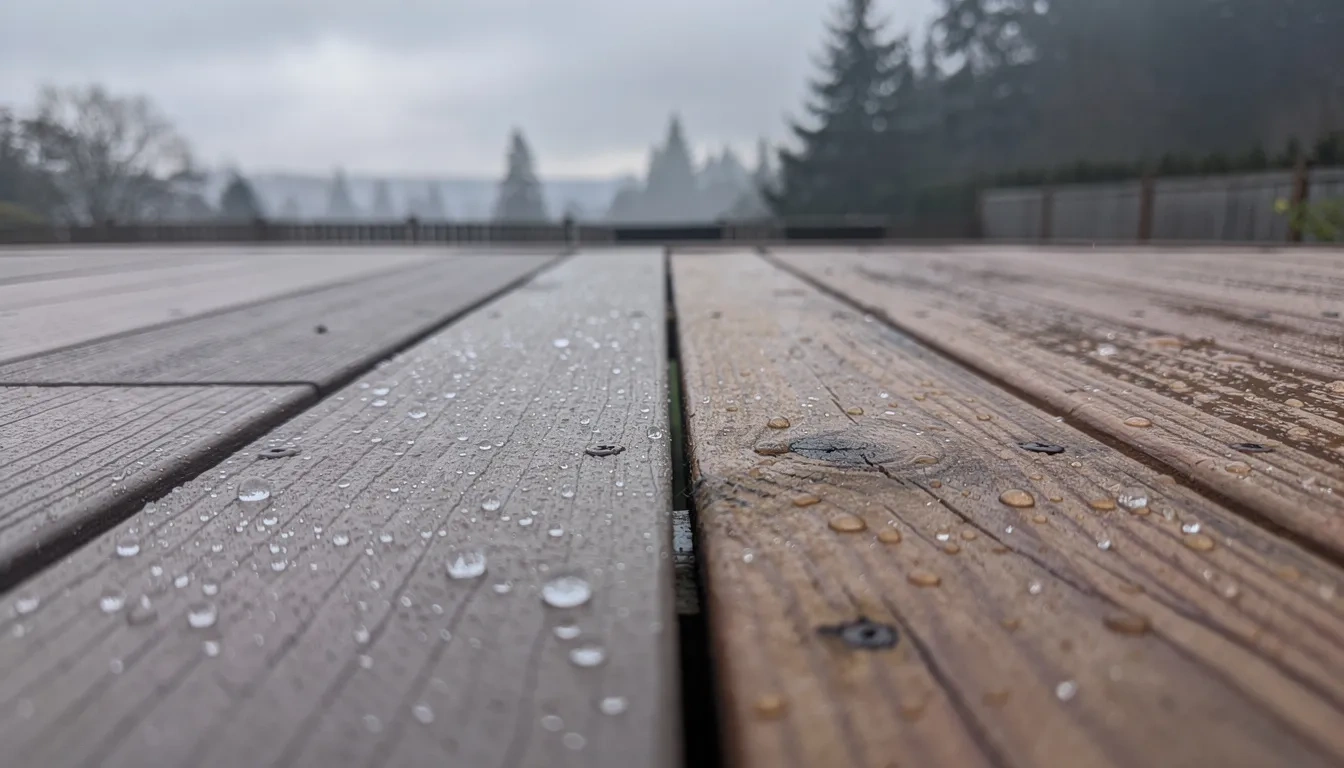
The boards should look slightly damp with light dew visible. Evergreen trees should frame the background, and the sky should be gray rather than bright blue to emphasize Pacific Northwest conditions.
Reason 1 – How Cloud Cover and Direct Sunlight Change the Heat Equation
Seattle averages roughly 220 cloudy or partly cloudy days per year. That single statistic changes everything about how deck boards behave and how much heat they can actually store at the surface.
Thermal mass and thermal conductivity are different properties. Thermal mass describes how much heat energy a material can store. Thermal conductivity describes how fast heat moves through and out of that material. Wood acts like an insulator: once it warms up, it holds that warmth for a long time. Composite conducts heat more readily, which sounds bad until you realize it also releases heat faster when clouds block the sun.
For composite to build significant stored heat, it needs sustained direct sunlight and long hours of full sun. Under cloud cover, all surfaces trend close to ambient air temperature and show similar surface temperature readings regardless of material. The heat sink effect that makes some composite decking feel hot in the sun in Phoenix barely activates on a typical Puget Sound afternoon.
Picture a real Seattle summer day: marine layer until 10 a.m., three or four hours of sun exposure around midday, then clouds returning by 5 p.m. When shade arrives, composite boards drop back to comfortable barefoot temperature within 20-30 minutes. Wood holds onto that midday warmth longer. Most actual deck use in this region happens under exactly these mixed conditions, not under desert-style full sun exposure.
Reason 2 – Morning Dew, Moisture Retention, and Traditional Wood Decking
Pacific Northwest mornings often start in the 50s or low 60s with high humidity and visible dew coating outdoor surfaces. This moisture matters for surface heat performance in ways that rarely get discussed in national decking articles.
Wood fibers soak up overnight moisture. When sunlight finally hits, the water locked inside slows evaporation and can actually trap heat within the board as it warms. Traditional wood decking becomes a slow-warming, slow-cooling mass that stays warm longer once the sun finally dries it out, and older boards can warp, crack, and even splinter as that moisture cycle repeats year after year.
Capped composite decking is largely non-porous at the surface. Morning dew sits on top of the cap layer rather than soaking in. As air temperature rises and the surface warms, that moisture evaporates quickly. Evaporation is an endothermic process. It pulls heat away from the surface. The deck boards essentially air-condition themselves during the first few hours of sun, acting like a simple, passive heat-resistant layer under your feet.
Here is the practical difference: at 10 a.m. on a 72°F July morning in Seattle, a modern light gray composite board can feel cooler underfoot than a damp, weathered cedar board that is slowly warming and holding heat. ¹ Run the same test in Phoenix, and the results flip because there is no morning dew to create that evaporative cooling effect.
Reason 3 – Heat-Resistant Color Technology Means Composite Is Less Hot in the Sun
The “composite is scorching” reputation traces back to first-generation composite decking products from the early 2000s. Those boards were dark, dense, and lacked the protective cap technology that modern decking products feature. They absolutely got hot in the sun. That reputation stuck long after the products improved.
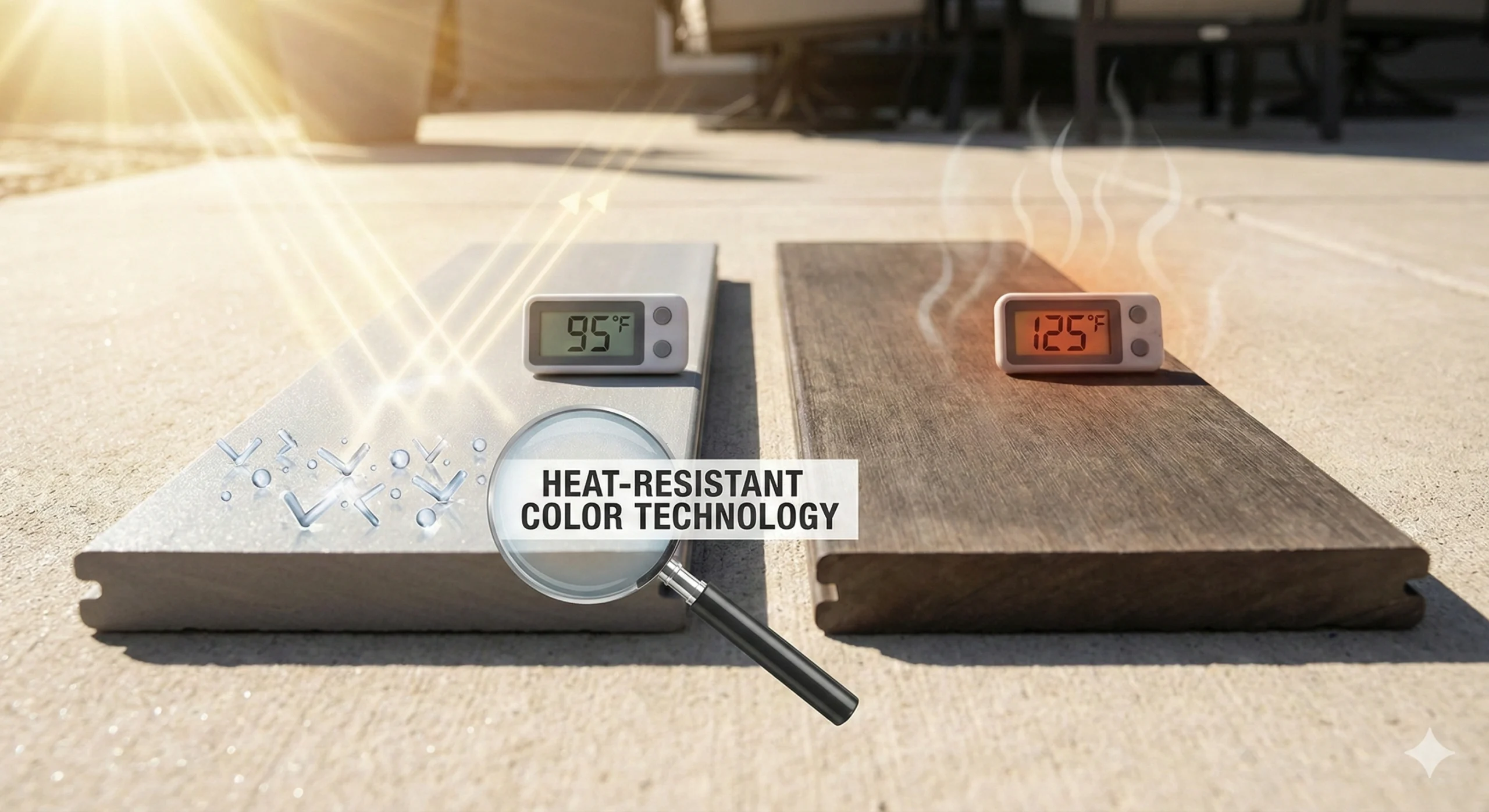
Current Trex Transcend Lineage, Azek Vintage collection, and TimberTech Advanced PVC series – flagship Trex decking and PVC lines in the industry — use reflective pigments, lighter cores beneath the cap layer, and heat mitigating technology baked into the shell. These innovations bounce more solar energy away from the surface rather than absorbing it, so the deck boards retain less heat and cool down faster when clouds roll in. Modern heat-resistant composite decking reflects heat with advanced surface technology.²
Testing commonly shows current-generation light gray composite boards measuring 15–20°F cooler than uncapped, dark composite boards from around 2008 under identical direct-sunlight conditions, a meaningful drop in surface temperature you can feel immediately under bare feet. That temperature difference is the gap between comfortable and painful for bare feet. Heat-resistant composite decking options can reduce surface temperatures by up to 30 degrees Fahrenheit compared to standard composite decking. All decking materials will get hot in the sun, but some composite options are engineered to mitigate heat absorption.
Many online complaints about deck heat come from pre-2015 forums discussing products that have been discontinued for years. Homeowners planning a new composite deck installation should compare current manufacturer data for heat-resistant decking material rather than decade-old anecdotes. Color selection still matters, too. Lighter colors in the gray, tan, and weathered-wood families perform best. The Brownstone tones and soft tans from current Trex decking lines stay noticeably cooler than deep charcoals or dark browns, which are better suited to heavily shaded yards or partial shade conditions where heat is less of a concern.
Reason 4 – Traditional Wood’s Dark Secret: Oxidation and Graying
Fresh cedar or fir decks in wet climates often start as warm honey or light brown tones. That beauty fades fast. Within 6-12 months, unsealed boards oxidize to a darker gray or silver. The transformation is not just cosmetic.
Darker surfaces absorb more solar energy. A deck that started light and reflected more sunlight becomes a heat absorption surface after a year of weather exposure. Those rare cloudless summer afternoons hit older wood decks harder because the material has drifted toward the hotter end of the color spectrum.
Keeping wood bright requires maintenance cycles: washing, sanding, and staining. Most contractors recommend refreshing the stain every 1-2 years in Pacific climates.³
Most homeowners skip that schedule. Without consistent upkeep, wood continues darkening, cracking, and absorbing more heat each passing season. Painting or staining becomes a constant battle against nature.
Composite holds its initial color profile for 25 years or more. The surface resists fading from UV exposure, so your deck style stays consistent without cosmetic touch-ups. A light gray composite board in year 10 looks like a light gray board, not a patchy, dark, weathered surface. Over the full life of a deck, a well-chosen light composite color stays closer to “cool” than a once-light wood surface that has drifted darker and rougher over time.
Reason 5 – Airflow and Substructure Design Matter More Than Material in Your Outdoor Space
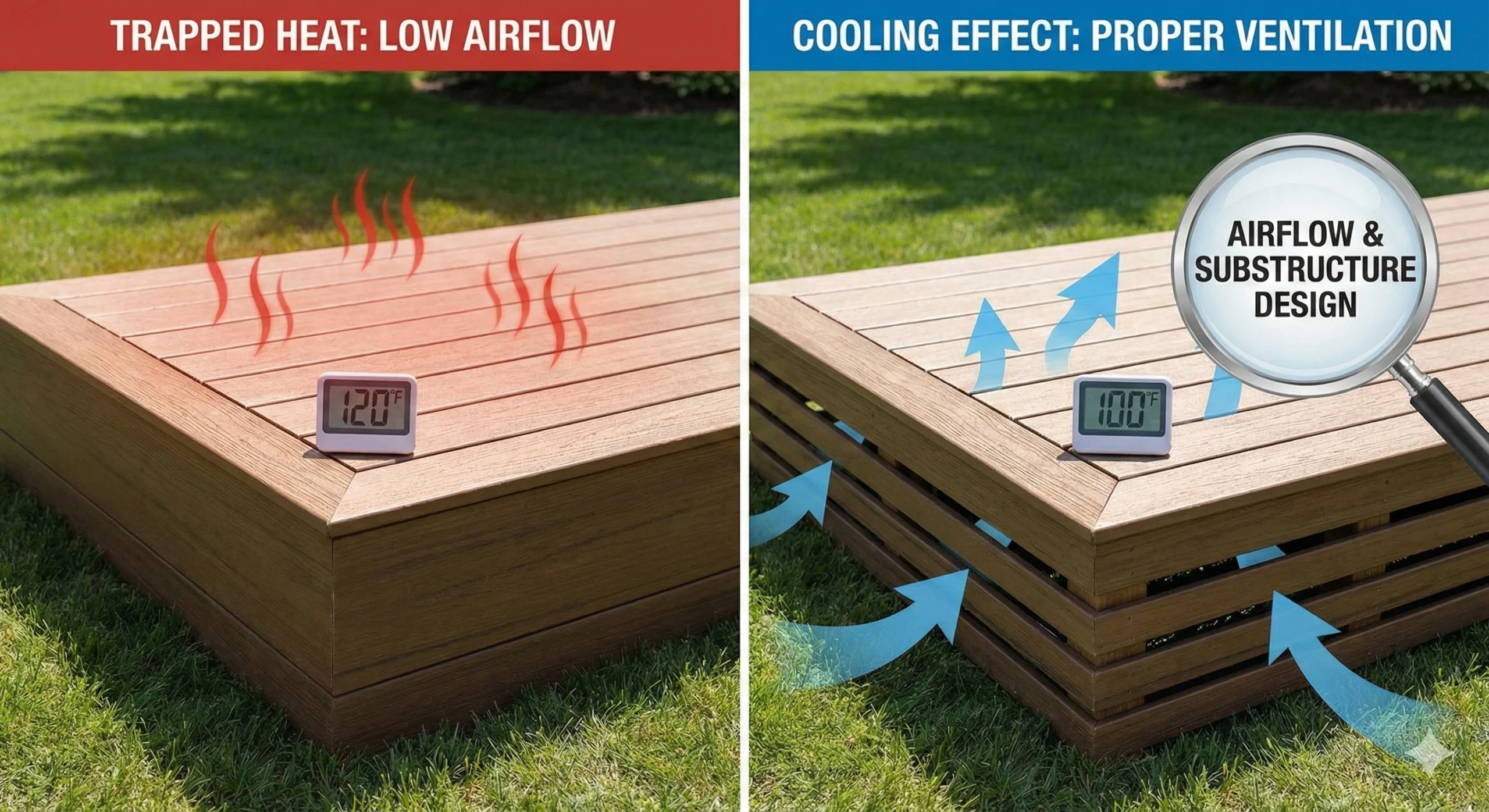
The biggest driver of whether any deck feels hot is often how well air moves under and around the boards, regardless of whether you chose composite decking or traditional wood. This variable gets overlooked in material debates, but it can make a 10-15°F difference in surface temperature.
Low, ground-hugging decks with solid skirting trap warm air beneath the structure. Heat radiates from the boards downward, has nowhere to escape, and radiates back up into the walking surface. Both wood and composite run hotter when airflow is choked off.
Best practice for cooler deck performance is to aim for at least 18 inches of clearance from soil to joist bottom on typical projects, with even more room on wet or poorly drained sites. Ventilated or slatted skirting allows cool air to draw in from below while hot air escapes through gaps at the fascia. Open stringer stairs improve circulation compared to closed riser designs.
The same Trex or TimberTech surface can feel dramatically different depending on how the substructure was designed. A deck built with proper airflow stays more comfortable than an identical surface installed directly over a concrete patio with no room for air movement.
Working with a contractor familiar with the full deck building process in regional conditions helps homeowners get these hidden details right and choose materials that match how their outdoor space is actually used. Material selection is one decision among many that affect barefoot comfort.
When Traditional Wood Decking Actually Wins on Temperature
Honesty builds credibility. Wood does perform slightly better in one specific scenario.
Picture a south-facing deck on one of Seattle’s 15-20 truly cloudless summer days.⁴ Four to six hours of continuous, high-angle sun with low humidity and no cloud cover. A well-maintained, light-stained cedar deck in that narrow window can feel marginally cooler underfoot than a dark-toned composite board of similar exposure.
Homeowners who primarily use their outdoor space during peak midafternoon hours on these hot days, and who commit to annual sanding and staining, may prefer wood for tactile feel alone. That is a valid choice.
For the remaining 345+ days of mixed and overcast conditions, modern light-colored composite tends to match or outperform wood on barefoot comfort while requiring zero maintenance to retain its thermal performance. The low maintenance advantage compounds over time as wood darkens and composite stays cooler.
Ignore Desert Myths, Trust Pacific Physics and Low-Maintenance Comfort
Thermal mass criticism of composite comes from lab tests and hot-climate experience that do not mirror Seattle’s cloud patterns and moisture cycle. Those tests assume conditions that rarely exist in the Pacific Northwest.
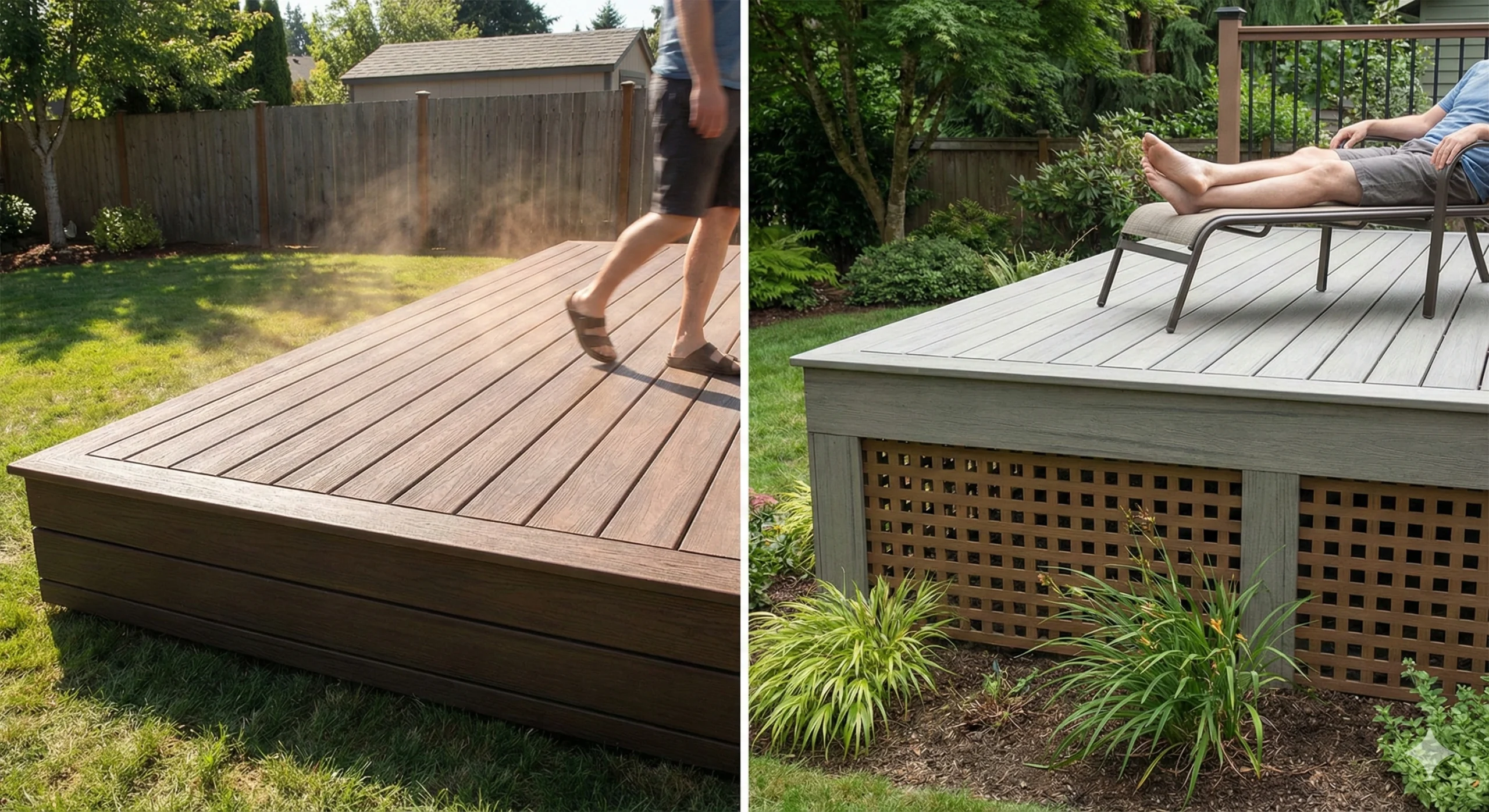
The key drivers favor composite in this region: frequent overcast skies limit heat accumulation, morning dew creates evaporative cooling on non-porous surfaces, modern heat-resistant composite technology reflects more solar energy, and thoughtful airflow design releases heat faster than trapped substructures.
Pacific Northwest homeowners should evaluate their own site conditions and usage times rather than relying on generic national blog posts about deck temperatures. Consider sun exposure patterns, shade from trees or structures, and how the deck will be used throughout the day and year.
In Puget Sound weather, choosing composite for durability, rot resistance, and low maintenance does not mean sacrificing comfort under bare feet. The physics of the region are on your side.
FAQ: Composite Deck Temperature In Pacific Northwest Weather
Do newer composite decking brands actually stay cooler than older products?
Post-2015 lines from Trex, Azek, and TimberTech use improved caps, reflective pigments, and lighter cores that often measure 15–25°F cooler than early-generation composite boards of similar color in direct-sun tests. Innovative technology in current products addresses the heat problems that gave composite its hot reputation. Homeowners in the Pacific Northwest with older composite decks may find that resurfacing with current boards can noticeably improve both temperature performance and appearance.
Which composite deck colors are best for the coolest surface in Seattle?
Light grays, soft tans, and weathered-wood tones deliver the best thermal performance. Examples include the lighter shades in Trex Transcend, Azek Vintage, and TimberTech collections. These lighter colors reflect more sunlight and retain less heat than darker options.
Very dark browns and charcoals absorb significantly more solar energy. Those tones work better on heavily shaded yards or north-facing decks where direct sun is limited. If your deck faces south or west with minimal tree cover, prioritize light color selection for a cooler deck surface.
Can I make an existing composite deck feel cooler without rebuilding it?
Adding shade elements like pergolas, sail shades, or retractable awnings over the hottest zones cuts direct sun exposure hours and can make a significant temperature difference. Improving under-deck airflow by replacing solid skirting with vented designs allows trapped heat to escape. Outdoor rugs in key barefoot areas provide additional comfort in high-traffic zones.
Is there any official rating that tells me how “cool” a composite deck will be?
No universal “cool deck” label exists yet. However, ASTM D7032 testing includes thermal performance measurements, and some manufacturers publish Solar Reflectance Index (SRI) numbers that indicate how much solar energy a surface reflects versus absorbs.⁵ Higher SRI means a cooler surface. Ask manufacturers or your local dealer for SRI data or comparative heat-test results when deciding between colors and product lines.⁶ Expert advice from regional contractors can help interpret these specs for your specific climate.
How does composite deck temperature compare to concrete patios or pavers in this climate?
Concrete and dark pavers often run significantly hotter than composite in summer sun. Concrete has high thermal mass, absorbs radiation aggressively, and has no airflow beneath the surface to dissipate heat. Dark pavers create similar problems.
A light-colored composite deck with proper ventilation beneath can measure 20–40°F cooler than adjacent concrete patios under identical conditions. Replacing a portion of a concrete patio with a ventilated composite deck platform can create a noticeably more inviting and comfortable lounging space on warm days.
If you’re planning a new deck or outdoor upgrade and want reliable guidance from experienced professionals, we’re ready to help.
👉 Contact Olympic Decks to discuss your project

Olympic Decks is your Seattle area Deck Company, We specialize in all your Decking needs – new deck installation, deck resurfacing, louvered roof and cedar wood fence installation.


