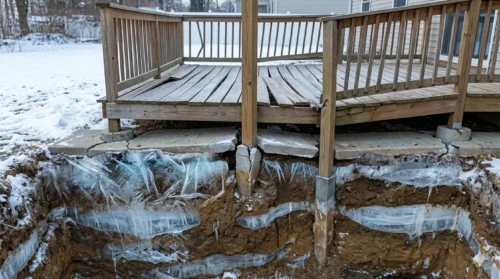
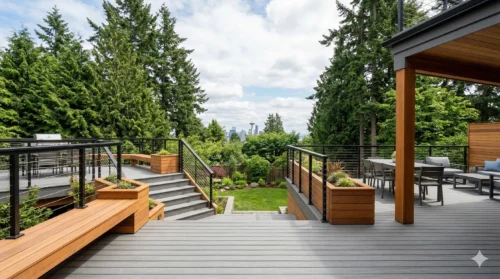
Deck inspections for multilevel decks tend to reveal a different set of problems than many people expect. A multi-level deck can do a lot for a house. It can break up a sloped backyard, create a more usable outdoor living space, and turn that layout into a more functional outdoor living area for a family. It can create separate zones for dining, relaxing, or moving between the patio, walkway, and the rest of the yard. In the right backyard, it can also create more room for daily use without wasting space. For a growing family, that added flexibility is often one of the clearest benefits. It can also hide trouble in more places.
That is the tradeoff. The more a deck changes height, direction, and function, the more its frame, stairs, railing, and support points have to work together across each deck level. A problem that would be easy to spot on a single-level deck can stay out of view longer on multilevel decks.
That is usually where our Olympic Decks team steps in. The real question is not whether a deck still looks good from the lawn. It is whether the structure is still doing its job.
Why deck inspections matter more for outdoor living on a multi-level deck
A level deck is not necessarily simple, but it is easier to read. The load path is clearer. The support pattern is easier to follow. Water has fewer places to stall, drift, or collect in awkward transitions.
A multi-level deck is different. Once you add an upper deck, a lower deck, several stair runs, and framing that spans different elevations, the structure becomes more complex in practical ways. There are more opportunities for movement, more places where moisture can collect, and more potential for uneven settling over time. That does not mean a multi-level deck is a mistake. Some of the most effective multi-level deck ideas come from yards where the land already drops, homes where the grade shifts around the foundation, or layouts where homeowners want clearly defined areas for a grill, a dining area, a lounge space, or a pool deck or hot tub area. Good multi-level deck ideas can also add dimension while maximizing limited space around the house, especially when the deck is built to improve access between the patio, the yard, and adjacent outdoor areas, including a side yard with brick and landscaping. In some cases, the most effective solutions come from a layout built around actual grade changes instead of forcing a flat design.
But those same design choices add inspection points. More levels mean more transitions. More transitions mean more places where fasteners loosen, water sits, and one part of the structure starts behaving differently from the part connected to it.
Red flag 1: Movement where the stairs connect between each deck level
If there is one place to begin during an inspection, it is the stairs.
On a multi-level structure, the stair system is not just a convenience feature. It is a structural transition between one level deck section and another deck level. If the stairs feel bouncy, drift to one side, or shift where they meet the landing, that is not something to write off as age or normal wear.1 It can point to movement at the connection, loosening hardware, or support issues at the base near ground level. This is one of the first places to inspect because stairs often bridge one level to the next and connect upper sections back to ground level access. In one instance, that movement may start where the stair assembly is attached back to the frame rather than at the tread itself.
This matters even more when the stairway is carrying regular traffic between the upper and lower portions of the deck. A small amount of play at the top can translate into more stress on the deck frame below. In some cases, the problem is at the landing. In others, the issue sits at the base where the stair support meets the ground and starts reacting to moisture, slope, or poor drainage. When the upper deck and lower deck stop behaving as one connected system, the warning signs usually begin here.
The point is simple. On multilevel decks, movement at the stairs is rarely an isolated cosmetic issue.
Red flag 2: A railing that moves more than it should
A loose railing is never a detail to ignore, but it carries more weight on elevated sections, especially on an upper deck where the drop is greater, and the consequences are more obvious. One basic check is to push firmly against the railing and see whether it holds steady under pressure without noticeable movement.2
Homeowners sometimes focus on the boards underfoot and miss what railing posts reveal about the structure around them. If a post wobbles, the problem may not be limited to the post itself. The connection to the deck frame may be compromised. Moisture may have weakened the surrounding wood frame, nearby blocking, or other wood components. Fasteners may be pulling loose. In some cases, the original construction did not account for the load railing sections that take at corners, stair openings, or busy traffic points. On an upper deck, that kind of railing movement is a safety concern, not just a maintenance detail.
This is one reason deck inspections on a multi-level deck have to look beyond the obvious. A deck can still feel usable while the railing system is quietly telling you the structure has started to lose integrity.
Red flag 3: Hidden moisture damage where lower levels meet
Water is patient. It does not need a dramatic failure point. It just needs time, a vulnerable joint, and a place where drying is slower than it should be.
That is why framing transitions deserve a closer look during deck inspections than many homeowners expect. On multilevel decks, problems often develop where one level connects to another, where the frame turns, or where a section ties back into the house. These spots are harder to ventilate properly, less visible during casual checks, and easier to miss during routine maintenance. In higher-risk areas, waterproof membrane tape over joists and beams can help limit water absorption and reduce the chance of rot where moisture tends to linger.3
The issue may start below before anything looks wrong on the surface. You might notice a soft feel under one stretch of boards, minor staining, or a slight dip that was not there before. That can be enough to suggest deeper damage in the frame. If the deck includes a hot tub, a pool deck, or any area that sees more regular water exposure, the risk goes up. So does the need to inspect beyond the surface layer. In some cases, one side of the deck stays drier while the connected section closer to the house or porch holds moisture longer.
This is also where homeowners need to understand when deck resurfacing makes sense. Fresh boards can improve a worn deck floor, but resurfacing only works when the structural system beneath it is still sound. If moisture has already compromised the frame, a nicer-looking surface does not solve the real problem.
Red flag 4: Uneven settling across different levels in an outdoor living space
A deck does not have to collapse to show signs of foundation trouble. More often, it starts with subtle misalignment.
On a multi-level deck, support points are often spread across different elevations, footing conditions, and moisture patterns on the property. One part of the structure may stay stable while another starts to settle. When that happens, the whole system can feel slightly off before the cause becomes visible. This is one reason a multi-level deck on a slope needs closer inspection than a single-level deck built on flatter ground.
A gap opens where two sections used to sit tight. A railing line looks less straight. A landing feels uneven. The lower levels may start reacting to soil movement while the upper section remains relatively fixed. In a sloped backyard, that difference can show up sooner because drainage and soil pressure are not consistent from one area to another. It is a good example of how lower levels and upper framing can respond differently across the same deck, especially when part of the project is located closer to wetter soil conditions. The center of the structure may still feel stable even while the outside sections start to move.
This is where the best multi-level deck ideas run into real-world conditions. A design can create better flow, add dimension, and make the most of limited space, but it still has to respect how the site behaves over time. If the supports were not built for those conditions, the deck will eventually show signs of it.
Red flag 5: Repairs that fix the look but not the structure
This is the one homeowners want to believe is not true. If the deck still reads as mostly intact, there is a strong temptation to patch the visible parts and move on.
Sometimes that is reasonable. Sometimes a project is limited to surface wear, isolated board replacement, or localized hardware updates. But a multi-level deck can make a partial fix look more complete than it really is. Because the layout is broken into different areas, one problem section does not always make the whole structure appear distressed.
That is why a smart inspection has to separate finish issues from structural ones. Weathered boards, fading, or tired-looking wood do not automatically mean the deck is failing. At the same time, a recently refreshed surface does not prove the structure is healthy. If the frame has started to move, if the stairs have lost stability, or if water has been working into key connections, cosmetic improvements will only buy time.
When a professional inspection is the better call
Most homeowners can spot a loose board, a visible gap, or an obvious lean. What they usually cannot determine with confidence is whether the problem is isolated or part of a larger structural shift.
That is where a professional inspection becomes worth it. On a level deck, the answer may be fairly direct. On multilevel decks, it often is not. You are evaluating how multiple sections are connected, how loads move between them, and whether one failing area is starting to affect the rest.
A good contractor should not reduce that process to a sales pitch. They should be able to explain what they see, why it matters, and what kind of repair fits the condition of the structure. That is also why it helps to understand what to look for in a deck contractor before committing to any larger work.
What homeowners should take seriously first in a multi-level deck living space
If a multi-level deck is starting to change, the priority is not cosmetic wear. The first things to take seriously are signs of movement, moisture intrusion, or weakening connections between one deck level and another. Those are usually the issues that spread fastest and lead to broader repair work if they are ignored. For homeowners trying to protect usable space, preserve room for family activity, and avoid bigger structural issues later, those early warning signs matter most.
What these warning signs can cost if they are ignored
On a multi-level deck, small structural changes rarely stay small for long. In the Seattle-area market, the more useful number is usually not the cost of a single board. It is the cost of waiting until movement, moisture, or railing instability spreads into a larger repair scope. That is one reason many homeowners explore repair options earlier instead of waiting for a rebuild after new materials are installed. In practice, the right services often begin with inspection rather than immediate replacement.
| Issue | What the work may involve | Typical current range |
| Surface decking damage | Replacing damaged decking boards or repairing localized deck sections | From about $10 to $50 per sq. ft. for deck repair, depending on extent and material |
| Worn or replaced decking surface | Installing new wood decking boards over a sound structural base | From about $11.50 to $14.80 per sq. ft. for wood decking installation, before more complex framing, stairs, or railing work |
| Loose or failing railing sections | Rebuilding or replacing railing runs, posts, and related hardware | From about $650 to $3,400 per project |
| Full deck replacement scope | Rebuilding a deck instead of continuing piecemeal repairs | In Seattle, many full deck projects start around $37 to $74 per sq. ft., with higher costs for more complex or elevated builds |
| Composite board material example | Current retail composite decking board pricing can already add up before labor | Current examples run from about $4.36 to $5.67 per sq. ft. for Trex Enhance boards |
That is why early inspection matters. If stairs start shifting, railing posts move, or one deck level begins settling differently from another, the smartest move is usually to inspect the structure before the repair scope expands. On a multi-level deck, delay often turns a targeted fix into a broader project involving framing, railing, stairs, and multiple connected sections. It also reduces the long-term benefits of a layout that was meant to improve access, add usable room, and support everyday outdoor use.
The goal is not to make every deck look new. It is to keep the structure safe, functional, and worth maintaining as part of the house and outdoor living space. For homeowners who use the deck for dining, entertaining, and moving between the patio and yard, the real benefits come from keeping that structure reliable while maximizing long-term use.
FAQ
How often should multilevel decks be inspected?
At least once a year is a smart baseline, especially if the deck has multiple stair runs or exposed framing transitions. It is also smart to inspect sooner if new boards, railing sections, or hardware were recently installed.
What is the biggest risk on multi level deck ideas with stairs and split elevations?
Movement at connection points is one of the most common concerns because one unstable section can affect the rest of the structure.
Are stairs usually the first part to fail?
Not always, but stairs often reveal structural movement early because they link different deck levels.
Can deck resurfacing fix a soft spot?
Not by itself. If the softness comes from frame damage or trapped moisture, the structure needs to be addressed first.
Do upper deck railings need special attention?
Yes. Any looseness on an elevated railing section should be taken seriously and inspected closely.
Why can a pool deck or multilevel deck settle unevenly?
Different footing conditions, slope, drainage, and soil movement can affect one section more than another over time.
Is a multi-level deck harder to inspect than a single-level deck?
Usually yes. More levels create more transitions, more framing intersections, and more places for problems to stay hidden.
When should I call a deck contractor instead of checking it myself?
Call one when you notice movement, recurring moisture issues, sagging, railing instability, or changes between levels that you cannot fully explain. It also makes sense to explore professional help before guests start noticing the same problems during regular use.

Olympic Decks is your Seattle area Deck Company, We specialize in all your Decking needs – new deck installation, deck resurfacing, louvered roof and cedar wood fence installation.